



Your team has an AI subscription. Someone has built a useful prompt. Someone else has connected a few tools. There are promising demos, a growing list of ideas and a question that gets harder to answer: what has actually improved?
The problem may be that each experiment solves a different fragment of the work. A draft arrives faster, but still needs extensive checking. Research is easier to collect, but difficult to trust. One colleague gets excellent results that nobody else can reproduce.
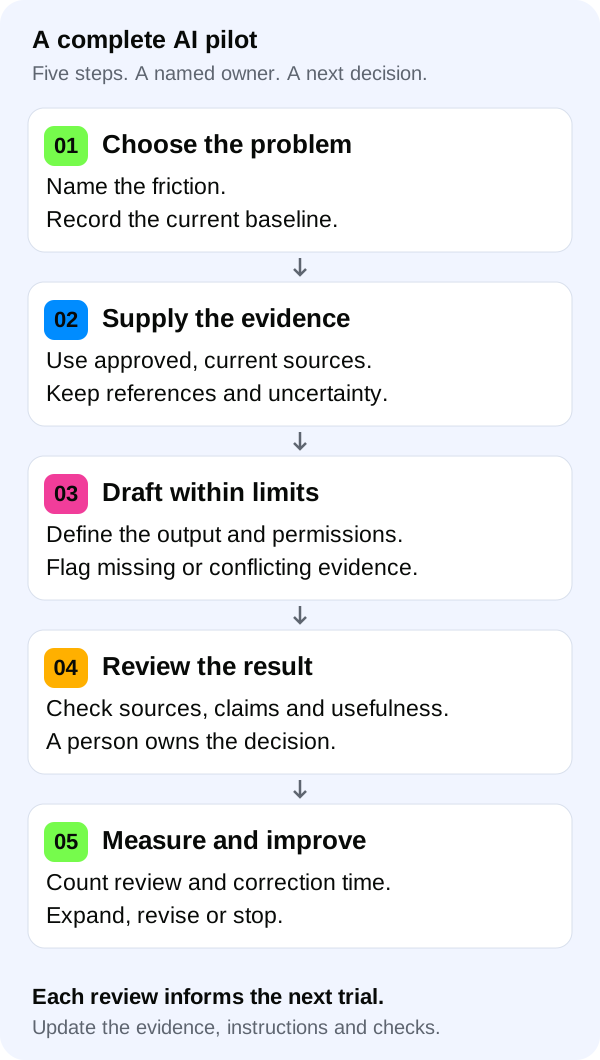
My view is that a useful AI strategy should make a piece of marketing work dependable. You should be able to explain what goes in, what comes out, who checks it and how you know the result is worth the effort.
This guide takes one illustrative example from first experiment to a decision about whether to expand: turning customer questions into a campaign brief. You can apply the same approach to account research, reporting, content adaptation or another recurring activity. The sequence matters more than a fixed timetable.
1. Choose a problem you can recognise on a Tuesday
“Use AI in marketing” is too broad to guide a decision. “Help our team prepare a better campaign brief from the customer evidence we already have” gives you something to investigate.
Start by asking the people doing the work where time goes, where mistakes recur and where useful information gets lost. Look for a task that happens often enough to test, has accessible inputs and produces an outcome someone can assess.
A sensible first candidate has three properties:
- The friction is visible. You can point to rework, delay, inconsistent quality or an unanswered customer question.
- A person can judge a good result. There is an experienced owner who can distinguish useful work from plausible filler.
- You can contain mistakes. A poor draft can be corrected before it changes a customer experience or spends money.
A broken process may need a simpler form, clearer ownership or conventional automation. If the job is an exact calculation or a fixed rule, start there. AI becomes a candidate when interpreting varied information or producing a reasoned draft is part of the difficulty.
Our example: a marketing team spends too long gathering sales objections and service questions before each campaign. Its first pilot will produce an evidence-backed brief for a human strategist to review. It will not publish content, contact customers or change a campaign.
2. Define “good” before asking for a draft
A fluent answer can make a weak brief look finished. Decide what the work must accomplish before you evaluate how polished it sounds.
For our campaign brief, the reviewer needs to answer five questions:
- Does it identify a specific audience and a decision that audience needs to make?
- Can each customer observation be traced to an approved source?
- Does it separate what customers said from our interpretation?
- Are the proposed message and claims consistent with what we can deliver?
- Can a colleague use the brief without reconstructing the research?
Keep a few examples of work your team considers strong, with notes explaining why. Include a weak example too. “This sounds generic” is less useful than “this brief names three audiences but never chooses which one the campaign should address”.
Measure the existing process before introducing AI. How long does gathering, drafting and reviewing take? How often is a brief sent back? What typically needs correcting? A small sample will not establish a universal benchmark, but it will give your pilot a comparison grounded in your own work.
3. Give the system evidence, context and limits
The model needs enough information to do the job. An indiscriminate pile of files makes it harder to see which information is current, relevant and authoritative.
For this pilot, assemble a deliberately small evidence pack: selected sales-call notes, recurring service questions, the current offer, approved claims and a good campaign brief. Use material you are authorised to process, remove unnecessary personal details and keep access appropriate to the people involved.
Preserve dates and source references. An objection from a discontinued offer should not silently become the basis of the next campaign. One unusually vocal customer should not become “what the market thinks”.
The output should make uncertainty visible. It can report that several supplied conversations mention implementation effort. It should not imply that this represents most customers without evidence about the wider customer base.
A useful instruction: “For each proposed customer insight, cite the source, distinguish observation from interpretation, and flag conflicting or insufficient evidence. Do not invent quotations or fill evidence gaps with assumptions.”
Then test whether the system follows that instruction. A requirement in a prompt is a starting point for evaluation, not a guarantee.
4. Make the first result useful enough to challenge
Consider a fictional business selling a service that saves finance teams time. Its marketing emphasises faster reporting. In the material supplied for the pilot, prospective customers repeatedly ask how much effort implementation will require.
A weak AI brief might recommend “an engaging campaign about efficiency and seamless onboarding”. That adds attractive language without resolving the question.
A more useful brief would give the strategist something specific to assess:
- Audience: finance managers evaluating the service who need to plan their team's involvement.
- Observation: implementation workload appears in several of the supplied conversations. Source references accompany the finding.
- Interpretation: uncertainty about getting started may be delaying some decisions. Sales needs to confirm this.
- Proposed angle: explain what the customer's team will need to do before the time savings begin.
- Evidence required: a current implementation outline, responsibilities and examples the business has permission to share.
- Boundary: make no promise about setup time until the delivery team has checked it.
The brief might lead to an implementation guide, a clearer sales conversation or a change to the offer. A campaign is only one possible response. The value is helping the team make a better decision about what the customer needs.
That is why the reviewer must be able to reject the proposed direction. If the system always turns every finding into more content, it has quietly narrowed your strategy.
5. Decide what happens when the answer is wrong
Before connecting more tools, write down what the system may do and what it must hand back to a person.
In our pilot, it may read the approved evidence pack, group similar questions and draft a brief. The strategist verifies the evidence and chooses the direction. The person responsible for delivery approves statements about implementation. Publication remains a separate decision.
If sources conflict, the system flags the conflict. If evidence is missing, it identifies the gap. If an input is inaccessible, it reports that limitation rather than producing a seemingly complete brief.
Test awkward examples deliberately: an old price list, contradictory customer notes, a sparse evidence pack and a request to make an unsupported promise. These cases tell you whether the process remains useful when the work gets messy.
Choose one person who owns the pilot. They need authority to stop it, correct the instructions and decide when a change is ready to test. Shared enthusiasm is helpful; it does not replace ownership.
6. Count the work you still have to do
The time taken to generate a draft is a poor measure of the value delivered. Count preparation, checking, correction and exception handling as well.
Here is an illustrative calculation, not a performance claim. Suppose a brief previously took 120 minutes from gathering material to approval. With AI, preparing the evidence takes 20 minutes, generating and checking the draft takes 15, and review and corrections take another 50. The new total is 85 minutes. The saving is 35 minutes, provided the final quality is at least as good.
That might be worthwhile. It might also be too small to justify building an elaborate integration for a task performed only occasionally. Include setup effort, ongoing maintenance and tool costs in that decision.
Keep a simple record for each trial: total time, whether the result was accepted, the corrections required and any unsupported claims. Compare similar work. A straightforward brief and an unusually difficult one are not interchangeable evidence.
Watch for costs that have moved to another person. Saving the writer an hour while adding an hour to the strategist's review is a redistribution of work. It could still improve quality, but describe the benefit accurately.
Commercial results require a separate test. A stronger brief may improve a campaign, but changes in audience, offer, budget and timing can also affect performance. Do not attribute the entire result to AI because it participated in the process.
7. Expand when the evidence gives you a reason
Agree the decision rules before the pilot starts. Otherwise, an impressive demonstration can become the justification for continuing indefinitely.
- Expand when representative trials meet the team's quality standard, the full process delivers a worthwhile benefit, and someone can operate and maintain it.
- Revise when the idea is useful but recurring problems have a specific fix, such as outdated inputs or unclear review criteria.
- Stop when checking costs consume the benefit, necessary evidence is unavailable, or failures cannot be contained at an acceptable cost.
Set thresholds that fit your work. A small time saving on a frequent task can matter. A rare task may justify investment if the quality improvement is valuable enough. There is no percentage that makes every pilot successful.
For our example, the next step might be preparing draft content from an approved brief. That introduces new questions about voice, claims and creative quality. Evaluate those separately. A reliable briefing process does not establish that publication can safely become automatic.
Your first pilot, on one page
Before buying another tool or commissioning an integration, complete these eight lines with the person doing the work:
- Problem: Which recurring activity needs to improve, and for whom?
- Current baseline: What time, cost, rework or quality problem can we observe today?
- Inputs: Which approved sources will the pilot use, and who keeps them current?
- Output: What specific deliverable must it produce?
- Acceptance criteria: What must a reviewer verify before using it?
- Boundaries: What may the system do, and when must it stop or ask?
- Owner: Who reviews results, handles failures and maintains the process?
- Decision: What evidence will make us expand, revise or stop?
Download the editable pilot brief
If several lines are difficult to complete, that is useful information. You have found a question to resolve before turning an experiment into a dependency.
At AiDU, our focus is building and managing AI systems around the work of marketing, sales and customer service. The connection matters: a better marketing brief may begin with something sales heard and depend on something customer service understands.
A useful AI strategy gives that knowledge a dependable route into action. Start with one piece of work. Make the evidence visible. Keep responsibility clear. Earn the next step through what improves.